

Justice
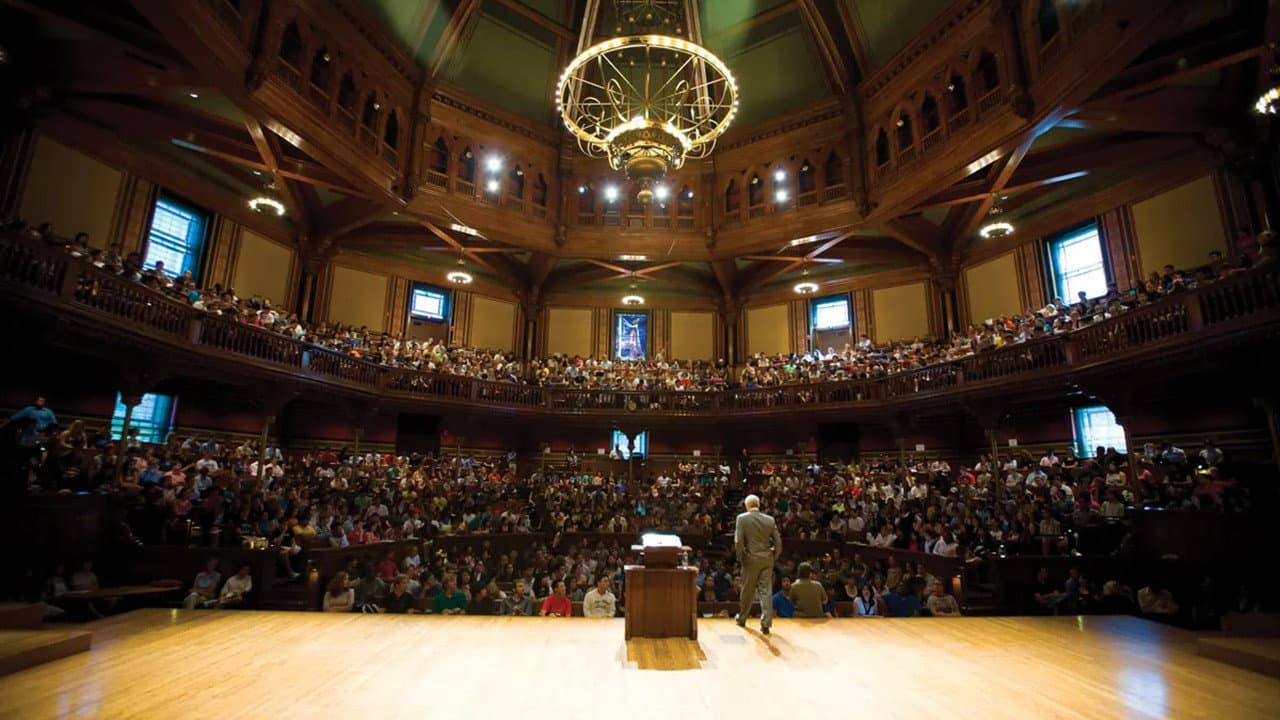
Justice is the first Harvard course to be made freely available online and on public television. In this 12-part series, college professor Michael Sandel challenges us with hard moral dilemmas and invites us to ponder the right thing to do—in politics and in our everyday lives.
Cast

Seasons & Episodes

E1The Moral Side of Murder/The Case for Cannibalism
Sep 13, 2009
If you had to choose between killing one person to save the lives of five others and doing nothing, even though you knew that five people would die right before your eyes if you did nothing—what would you do? What would be the right thing to do?

E2Putting a Price Tag on Life/How to Measure Pleasure
Sep 20, 2009
Sandel presents some contemporary cases in which cost-benefit analysis was used to put a dollar value on human life. The cases give rise to several objections to the utilitarian logic of seeking “the greatest good for the greatest number.” Is it possible to sum up and compare all values using a common measure like money?

E3Free to Choose/Who Owns Me?
Sep 27, 2009
Sandel introduces the libertarian notion that redistributive taxation—taxing the rich to give to the poor—is akin to forced labor. If you live in a society that has a system of progressive taxation, aren’t you obligated to pay your taxes? Don’t many rich people often acquire their wealth through sheer luck or family fortune?

E4The Land is My Land/Consenting Adults
Oct 4, 2009
The philosopher John Locke believes that individuals have certain rights—to life, liberty, and property—which were given to us as human beings in the “the state of nature,” a time before government and laws were created. According to Locke, our natural rights are governed by the law of nature, known by reason, which says that we can neither give them up nor take them away from anyone else.

E5Hired Guns?/For Sale: Motherhood
Oct 11, 2009
During the Civil War, men drafted into war had the option of hiring substitutes to fight in their place. Many students say they find that policy unjust, arguing that it is unfair to allow the affluent to avoid serving and risking their lives by paying less privileged citizens to fight in their place. Is today’s voluntary army open to the same objection? Professor Sandel examines the principle of free-market exchange as it relates to reproductive rights. Students debate the nature of informed consent, the morality of selling a human life, and the meaning of maternal rights.

E6Mind Your Motive/The Supreme Principle of Morality
Oct 18, 2009
Professor Sandel introduces Immanuel Kant, a challenging but influential philosopher. Kant rejects the notion that morality is about calculating consequences. When we act out of duty—doing something simply because it is right—only then do our actions have moral worth.

E7A Lesson In Lying/A Deal Is A Deal
Oct 25, 2009
Immanuel Kant believed that telling a lie, even a white lie, is a violation of one’s own dignity. Sandel introduces the modern philosopher, John Rawls, who argues that a fair set of principles would be those principles we would all agree to if we had to choose rules for our society and no one had any unfair bargaining power.

E8What's A Fair Start?/What Do We Deserve?
Nov 1, 2009
Rawls argues that even meritocracy—a distributive system that rewards effort—doesn’t go far enough in leveling the playing field because those who are naturally gifted will always get ahead. Furthermore, says Rawls, the naturally gifted can’t claim much credit because their success often depends on factors as arbitrary as birth order. Sandel discusses the fairness of pay differentials in modern society.

E9Arguing Affirmative Action/What's The Purpose?
Nov 8, 2009
Students discuss the pros and cons of affirmative action. Should we try to correct for inequality in educational backgrounds by taking race into consideration? Should we compensate for historical injustices such as slavery and segregation? Is the argument in favor of promoting diversity a valid one? How does it size up against the argument that a student’s efforts and achievements should carry more weight than factors that are out of his or her control and therefore arbitrary? When a university’s stated mission is to increase diversity, is it a violation of rights to deny a white person admission? Sandel introduces Aristotle and his theory of justice. He believes that justice is about giving people their due, what they deserve.

E10The Good Citizen/ Freedom Vs. Fit
Nov 15, 2009
Aristotle believes the purpose of politics is to promote and cultivate the virtue of its citizens. The telos or goal of the state and political community is the “good life”. And those citizens who contribute most to the purpose of the community are the ones who should be most rewarded. But how do we know the purpose of a community or a practice? How does Aristotle address the issue of individual rights and the freedom to choose? If our place in society is determined by where we best fit, doesn’t that eliminate personal choice? What if I am best suited to do one kind of work, but I want to do another?

E11The Claims Of Community/Where Our Loyaty Lies
Nov 22, 2009
Communitarians argue that, in addition to voluntary and universal duties, we also have obligations of membership, solidarity, and loyalty. These obligations are not necessarily based on consent. We inherit our past, and our identities, from our family, city, or country. But what happens if our obligations to our family or community come into conflict with our universal obligations to humanity? Do we owe more to our fellow citizens that to citizens of other countries? Is patriotism a virtue, or a prejudice for one’s own kind? If our identities are defined by the particular communities we inhabit, what becomes of universal human rights?

E12Debating Same-Sex Marriage/The Good Life
Nov 29, 2009
If principles of justice depend on the moral or intrinsic worth of the ends that rights serve, how should we deal with the fact that people hold different ideas and conceptions of what is good? Can we settle the matter without discussing the moral permissibility of homosexuality or the purpose of marriage? Sandel believes government can’t be neutral on difficult moral questions, such as same-sex marriage and abortion, and asks why we shouldn’t deliberate all issues—including economic and civic concerns—with that same moral and spiritual aspiration.
Storyline
Justice is the first Harvard course to be made freely available online and on public television. In this 12-part series, college professor Michael Sandel challenges us with hard moral dilemmas and invites us to ponder the right thing to do—in politics and in our everyday lives.
Recommended

History 101
2020

American Experience
1988

NOVA
1974

Top Gear
1978

Horizon
1964

Biography
1987

Quarterback
2023

Natural World
1983

Trust Me: The False Prophet
2026

Mind Field
2017

Hulk Hogan: Real American
2026

American Monster
2016

Dirty Money
2018

I AM A KILLER
2018

Arnold
2023

Through the Wormhole
2010

The National Parks: America's Best Idea
2009

The Men Who Built America
2012

The New York Times Presents
2020

Homicide Hunter: Lt Joe Kenda
2011
More Like This

The Widower
2021

Crimewatch Caught
2024

Rozsudek
2014

Justice with Michael Sandel
2009

Sophie: A Murder in West Cork
2021

Ma version des faits
2024
Unlocking the Truth
2016

La vérité sur la fausse avocate
2025

Caïds Story, un siècle de grand banditisme
2011

Michael Jackson: The Trial
2026

Sin City Justice
2017

Law of the Dragon
2011
Podle práva
2007

Stardust
2024

The Accused: Beyond Reasonable Doubt?
2026

Stephen: The Murder That Changed a Nation
2018

60 JUSTICE PROJECT
2018

Pointman
1994

The Good Wife
2009

Justified
2010