

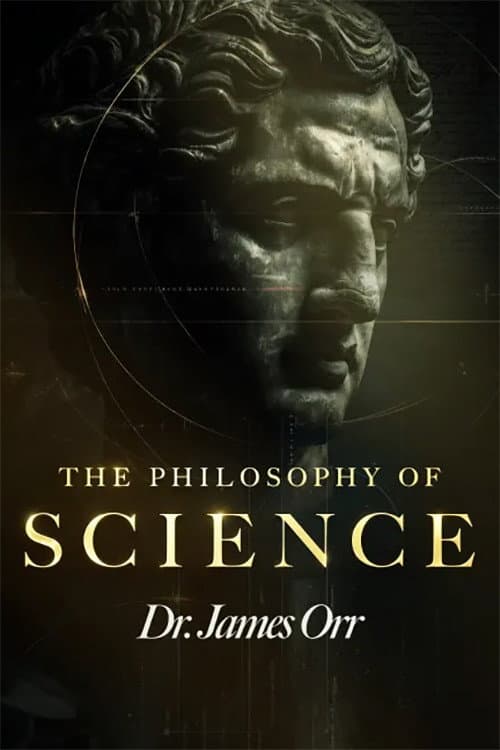
The Philosophy of Science
In The Philosophy of Science, an eight-hour course, Dr. James Orr traces the development of science from ancient Greece through the Scientific Revolution to today. He examines how theological, institutional, and philosophical forces shaped science, while tackling key issues like the demarcation problem of science versus pseudoscience, Hume’s problem of induction, Kuhn’s theory of paradigm shifts, and the realism debate. The course also engages fascinating unresolved questions raised by cosmology, neuroscience, and quantum mechanics, ultimately arguing that scientific progress does not eliminate philosophical inquiry but rather deepens it, revealing new mysteries that demand philosophical analysis.
Cast

Dr. James Orr
Host
Seasons
E1Science as Philosophy
Apr 30, 2026
In our introductory lecture, we explore the philosophy of science by examining the extraordinary dominance that science has achieved in contemporary culture, where it has become the benchmark for truth and reality. We trace scientific thinking from ancient Greece, where Thales and Anaximander replaced myth with natural explanations, to Aristotle’s emphasis on observation and reason. The lecture concludes by challenging Stephen Hawking's claim that "philosophy is dead," arguing instead that science remains fundamentally a branch of philosophy and that philosophical inquiry is essential for understanding science's methods, foundations, scope, and limitations.
E2The Scientific Revolution
Apr 30, 2026
In lecture two, Dr. Orr considers the Needham question, which asks why the scientific revolution emerged in medieval Europe rather than in more technologically advanced civilizations like China or the Islamic world. The lecture explores how medieval Christendom provided unique theological and institutional foundations—including the doctrine of creation ex nihilo, autonomous universities, and a view of nature as secular—that ultimately enabled the scientific revolution to flourish in 16th and 17th century Europe.
E3Scientific Thinkers
Apr 30, 2026
In lecture three, we study the scientific revolution through six figures: Copernicus, Galileo, Kepler, Descartes, Bacon, and Newton. We challenge the narrative that science progressed by breaking from religion, showing how these thinkers were motivated by theological beliefs. We examine their discoveries—heliocentrism, laws of motion, universal gravitation—and how they transformed natural philosophy. Dr. Orr demonstrates that these revolutionary thinkers viewed their work as natural philosophy aimed at understanding God's creation, suggesting the scientific revolution was a continuous evolution within a Christian intellectual universe rather than a radical rupture from it.
E4Origins of the "Scientist"
Apr 30, 2026
In lecture four, we explore the historical transition from natural philosophy to modern science during the 19th and 20th centuries, examining how the professionalization of science led to the view that all truths are scientific truths. We trace key developments including Darwin's Origin of Species, the Industrial Revolution's technological successes, and the coining of the term "scientist" in 1837. The lecture concludes by examining the Vienna Circle's logical positivism and its eventual failure, highlighting the philosophical tensions that arise when science attempts to explain all aspects of human experience, including consciousness, morality, and meaning.
E5Scientific Reasoning
Apr 30, 2026
In lecture five, we analyze two key challenges in philosophy of science. First, the demarcation problem: distinguishing genuine science from pseudoscience through Popper's falsification principle - scientific claims must be testable and potentially disprovable, unlike theories like psychoanalysis. Second, Hume's problem of induction questions how we justify using past experience to predict the future. We examine contemporary responses including Bayesian probability and the concept of abduction as alternative approaches to scientific reasoning, while acknowledging that the skeptical challenge remains largely unresolved in contemporary philosophy of science.
E6Progress in Science
Apr 30, 2026
In lecture six, we discuss how science changes and whether it makes progress. We examine Thomas Kuhn's paradigm shift theory, suggesting science replaces one map of reality with another without objective progress. We also consider quantum mechanics paradoxes like wave-particle duality and observer dependence, and the underdetermination of theory by evidence. Dr. Orr also addresses realism vs. anti-realism, featuring Putnam's no-miracles argument that theories must approximate truth to explain their success. We conclude by examining philosophy's essential role in understanding science.
E7Philosophy in Science
Apr 30, 2026
In lecture seven, we examine three fundamental concepts in philosophy of science: laws of nature, causation, and scientific explanation. We explore competing views on laws of nature, from Humean skepticism treating laws as mere regularities, to universals-based theories, to revived Aristotelian powers. We investigate parallel debates about causation and their role in scientific explanation. The lecture ultimately reveals deep philosophical disagreements about these foundational elements, demonstrating that scientific progress generates rather than eliminates philosophical questions.
E8Unanswered Questions
Apr 30, 2026
In our eighth and final lecture, we investigate four key areas where scientific advances have generated profound philosophical questions. We delve into cosmology and the Big Bang theory's impact on questions of existence, the biological distinction between life and non-life, neuroscience's relationship to consciousness and the mind-brain problem, and the philosophical puzzles arising from quantum mechanics. Dr. Orr demonstrates that scientific progress doesn’t replace philosophy—it deepens it, revealing that the more we discover, the more mysterious the world becomes and the more we need philosophical analysis to make sense of it.
Storyline
In The Philosophy of Science, an eight-hour course, Dr. James Orr traces the development of science from ancient Greece through the Scientific Revolution to today. He examines how theological, institutional, and philosophical forces shaped science, while tackling key issues like the demarcation problem of science versus pseudoscience, Hume’s problem of induction, Kuhn’s theory of paradigm shifts, and the realism debate. The course also engages fascinating unresolved questions raised by cosmology, neuroscience, and quantum mechanics, ultimately arguing that scientific progress does not eliminate philosophical inquiry but rather deepens it, revealing new mysteries that demand philosophical analysis.
Recommended
Horizon
1964

WWE 24
2015
History 101
2020

How Do They Do It?
2006

Top Gear
1978

Quarterback
2023

Eli Roth's History of Horror
2018
The Real History of Science Fiction
2014

Beyond Stranger Things
2017

Buzzfeed Unsolved: Supernatural
2016

30 for 30
2009

The World According to Jeff Goldblum
2019
More Like This

Titanic: Secrets of the Shipwreck
2025

Private Lives of the Monarchs
2017

Cosmos: A Personal Voyage
1980
MythBusters
2003

The Owl's Legacy
1989

Ciencia vs. Cáncer
2024

The Crocodile Hunter
1997

Great Minds Think for Themselves
1997
Horizon
1964

Antiques Roadshow
1979

Innovation Effect
2021

Once Upon a Time... Life
1987